Showing posts with label Myron Olson. Show all posts

Saturday, January 22, 2011

Limburger Helper

Limburger mac'n cheese with rye bread crumbs
Strong cheese has never scared me. Maybe that’s because I grew up eating stinkers, and I learned that, when melted, they turn sublime – even mellow. Take Limburger, a legendary whiffer traditionally eaten with purple onion and rye bread. It will stink up your kitchen, but when you melt it, ohhh my. The beefy flavor subsides and the creamy texture turns to satin.

This month, I was invited to create a recipe for a 30-day mac'n cheese project developed by the Wisconsin Milk Marketing Board. When they asked me what cheese I wanted to feature, I didn’t hesitate. Myron Olson’s Limbuger. This summer I visited Myron Olson, America’s last Limburger maker, at Chalet Cheese Cooperative in Green County, Wis. He won me over with his hairnet and big smile, and I enjoyed his history lesson about strong cheese.
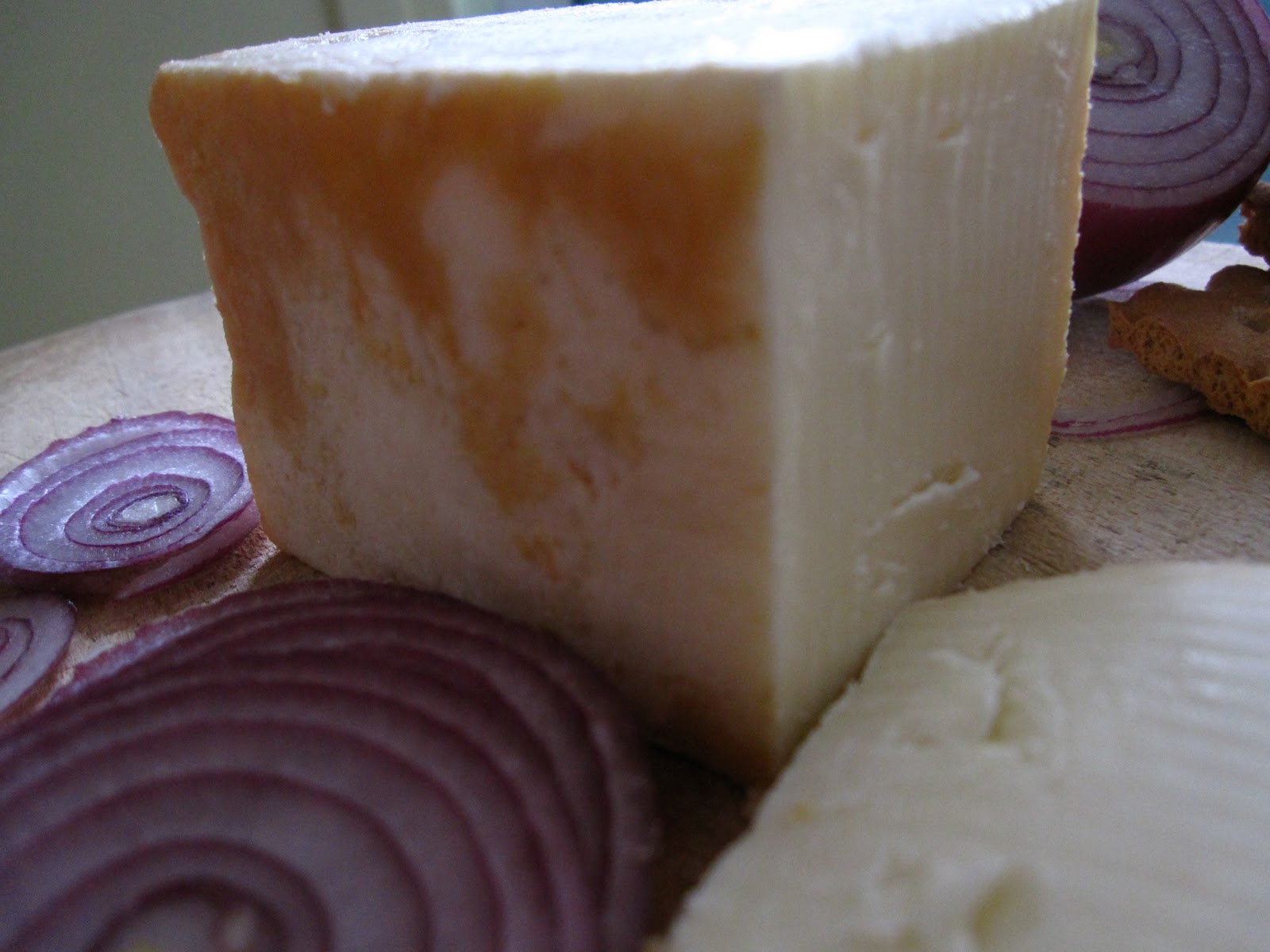

According to Myron, Limburger used to be a popular cheese among immigrants, especially Germans. Early Wisconsin cheesemakers made loads of Limburger, and the area around Monroe was home to many small plants. When cheese making industrialized, Limburger disappeared and the Kraft Single was born. What happened to the American palate? Cheese died, and Limburger got shelved.

Thankfully, Myron forages ahead. For more than forty years, he’s kept the tradition of smear-ripened cheese alive. He likes to eat Limburger with strawberry jam, he told me, but I am a traditionalist. I like it with mustard, raw onion, and rye bread or crackers. If this recipe can aid in lifting the stigma off stinky cheese, it really will have earned its name.

Limburger Helper
Serves 6

Ingredients:
1 6-ounce brick of Limburger cheese, edges trimmed, cubed
3 slices cured bacon
4 slices seedless rye bread, cubed
1 small purple onion, chopped
5 tablespoons butter
2 cups whole milk, warmed
¼ cup flour
1 tablespoon brown mustard
1 teaspoon salt
½ cup grated Parmesan
2 cups dry macaroni (or ½ lb)

Directions:
Chop onion and cube rye bread, then set aside. In a skillet, fry bacon until crisp, then set strips aside to cool. Reserve a tablespoon of bacon grease in the pan for sautéing chopped onion – sauté until edges turn brown, about five minutes.


To make breadcrumbs, melt 2 tablespoons butter in skillet and add cubed rye bread. Stir over medium heat until browned, about 10 minutes.

Boil pasta until the macaroni is al dente – it should stick to your teeth. While the pasta cooks, use a saucepan to melt remaining butter (3 tablespoons), then add flour. Whisk on medium heat for one minute to form a rough paste.


Slowly add warm milk, whisking constantly. Stir on medium heat, 10-15 minutes, or until the sauce has thickened. Remove sauce from heat and stir in brown mustard, Limburger cubes, salt, and ground pepper. Combine sauce with bacon, browned onions, and macaroni, in a large mixing bowl.


Ladle mixture into 6 oven-proof bowls or a square baking pan. Top with grated Parmesan and rye bread crumbs. Bake at 350 degrees for 30 minutes. Serve with a crisp wheat beer and grapes or pickles.

Note: If you use individual bowls, it's a breeze to reheat leftovers. This recipe is just as good, if not better, on the second day.


Tuesday, July 6, 2010

Curds 101: The DL from Limburger HQ


In Wisconsin, everyone loves a squeaky curd. In Philadelphia, most people have no idea what a curd is, let alone a squeaky one. I was at a party back in May when a New Yorker asked me, "So, what is a curd?" followed by, "So, how is cheese made?" Oh honey, he got an earful.

"A curd is like a unit of unripened cheese," I told him. "And a squeaky curd is super fresh. It actually goes wah-uh wah-uh against your teeth." He looked at me in disbelief.

Recently, I traveled back to 'Sconny to visit the fam, and I got to embark on tours of two cheese plants. The Wisconsin Milk Marketing Board set it all up for me and even gave me a shmancy tote bag. Such largesse! I felt pretty special and also kinda weird -- I don't know too many people who would wake up at 7 a.m. on their vacation to check out curd vats. But there I was, meeting Master Cheesemaker Myron Olson at the Chalet Cheese Co-op in Monroe, Wis. for a tour of his farmer-owned plant, the only producer of Limburger.
Olson has been a cheesemaker for 40 years, and he has the stride of a farmer. Big shoulders, slow walk. He smiles a lot, even when he's chewing, and he uses the word "shtink" with pride. I didn't mind putting on booties and a hair net for him.

First stop: the open vats where local milk is heated in tubs the size of Winnebagos. After rennet (a coagulant) is added, the milk solids settle to the bottom and the whey rises. I watched as two guys with cheese "harps" -- literally, metal frames strung with fine wire -- slowly raked the vats, a process called "cutting the curd."

When Olson reached in after the curds were cut, this vat of Limburger-to-be revealed handfuls of pebble-sized curds. Once these get pressed into forms, salted, and doused with special cultures, Limburger as we know it is born.
The Chalet Cheese-Coop is the only plant left in the country where traditional Limburger (and Liederkranz) is made. It's a real stinky hub.

I pecked at a few Limburger curds -- they were flavorless, like cottage cheese. After they are pressed and aged on pine boards, however, they turn into salty, oniony blocks of spreadable goodness. Olson let me sample Limburger at three different stages: an unripe Limburger tastes bland and chalky, at two months Limburger is creamy and pungent, and at three months Limburger is gooey and noxious, in the best possible way.

"Limburger is actually a probiotic cheese," Olson told me. "It's got a lot of good enzymes, so it's easy to digest. That might be why older folks like it." He chuckled. "Everyday I eat a piece of Limburger and I do stay healthy!"

Chalet Cheese Co-op does not appear to have a web site, although the company has fairly good distribution around the country at specialty cheese stores and many Whole Foods. New York, Florida, and Pennyslvania consume the most Limburger, believe it or not, which leads me to believe that some of my neighbors are holding out on me. I guess I'm not the only one who eats Limburger and strawberry-jam sandwiches around here.

Donna, pictured up top, is one of about 22 people on staff at Chalet Cheese Co-op. The company also produces German-style Brick cheese and award-winning Baby Swiss.

Note: for a list of factory tours around the state of Wisconsin, click here.