Showing posts with label Limburger. Show all posts

Saturday, January 28, 2012

Haunted by Handkäse


Readers, you know how I feel about stinky cheese. I always welcome it into my home. That is why there is a funeral-sized incense burner in my living room. Alas, my last Stinky Cheese Mission went awry, and I am still puzzling over it. Did I eat a bad piece of cheese, or is Handkäse really and truly intolerable?

The tip came from a reader who heard about Handkäse during a German conversation class in New Jersey. She asked if I knew of it, then sent me instructions on how to find it. “My German teacher calls it Handkase mit musik,” she wrote. “The musik comes afterward.”

Okay. I like a fart joke. I’ll eat a farty cheese.

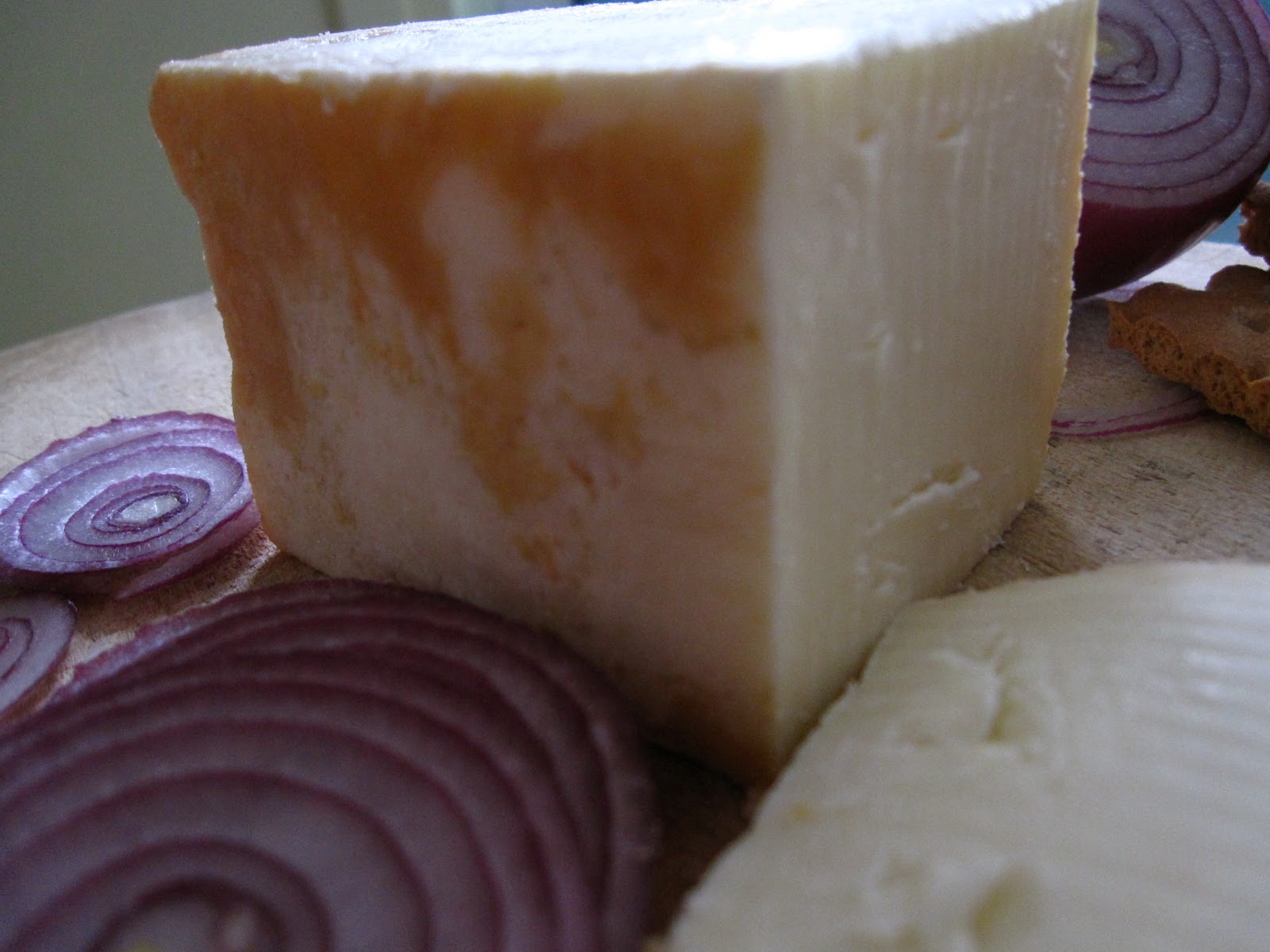
So off I went to Rieker’s Prime Meats, a German specialty foods store in the neighborhood of Fox Chase, Pa. I pictured a meaty fright wig of a cheese with a devilish rind, something akin to Limburger. I did not expect Handkäse to look umbilical, like a glassy Tootsie Roll. But, there it was in the cooler: slightly cloudy, tubular.

Let it be known that I loved Rieker’s Prime Meats. I loved the cuckoo clocks, the German cookies, the fresh spaetzle and rouladen in the dairy case. I bought bags of fresh pretzels, wursts, mustard in a toothpaste tube – all the family favorites. 


The only item I didn’t love when I got home? Handkäse. And it wasn’t the musik.

Handkäse is a specialty of Hesse, Germany, where it was originally rolled by hand, hence the name. According to Cookipedia, it’s a “smeared acid curd” cheese made from sour milk that is ripened for several days in a “sweating room.” New terms for this cheese geek. Acid curd? Sweating room?

You get the picture. Handkäse did taste sweaty and acidic – like sour cream mixed with rubber cement. My first bite stuck to my front teeth like a fetid gummi bear. Terrible. I tried melting it, added onions – as others on the internet suggested – but oy vey, that only made Handkäse turn slimy. 


If Tolkein’s Golem character had tried ripening a cheese in his cave, it might have looked like melted Handkäse. Look at it. Tell me you don't think of Lord of the Rings.

I’m headed back for some Limburger. I think I like cheese that smells like feet better than cheese that looks like a severed finger. But, readers, set me straight. Is there something I’m missing? Are there magical nuggets of Handkäse out there, or am I stinktarded?

Tuesday, November 8, 2011

The Call of Wild 'n Stinky Cheeses


I’m sure you feel it, too. The craving. When you catch a whiff of musty leaves on your walk to work, or when pull on a wool sweater that still smells a little sheepy -- those earthy, beasty smells make you want one thing: stinky cheese.

No? Seriously? Okay, I’m alone here, or maybe you just don’t want to admit it. There is something about November weather – all this dampness and decay – that makes yeasty, feisty cheeses kind of appealing. 

That’s why I’m excited to tell you about Stinky Føttene (pictured above), a new beefy champ from Hook’s Cheese Company out of Mineral Point, Wisconsin. I am especially proud of Tony and Julie Hook for calling this cheese what it is. The name literally meets “stinky feet.”

In the cheese world, people shy away from using the word “stinky” or “whiffy.” Most mongers and makers will use the term “pungent,” as if this is a kindler, gentler way to refer to certain “interesting” cheeses with “aromatic” qualities.

I prefer not to tiptoe. Stinky cheese has always been all right with me. I like to eat it with dark bread and dark beer, preferably in a darkish kitchen with maybe a little Hüsker Dü playing in the background.

Gateway Stinkers

Stinky Føttene is a good gateway stinker. “For a stinky cheese, it’s pretty palatable,” my friend Austin said, when I served him a wedge at a recent harvest party. My friend Tracy deemed it “the IPA of cheese.” I’d have to agree. Our wedge – airdropped in from a Wisconsin source – didn’t necessitate any nose plugs.

Still, it had all the qualities I like in a stinky washed-rind cheese: a gooey orange rind (from a good wash with saline or booze), a creamy texture, and a toothsome beef-stewy quality that is characteristic of stinky cheese.

What makes a cheese stinktastic? Most are washed-rind cheeses, which is a style of cheese that developed out of monastic cultures. Many early monasteries produced beer or spirits alongside cheese, and some sweet bald Man Of The Cloth finally put the two together. Think of Epoisses, a famous Googoo Cluster from the Trappists.

Washed-rind cheeses are literally bathed in a solution – brandy, beer, etc. – that adds flavor and moisture. No surprise, eating these stinkers alongside Trappist ales and dark liquor makes for a very merry pairing.

Must-Try Whiffies: From Mild to Wild

If you are sensitive to stink, ask a cheesemonger to help you find the right round for you. Stinky cheeses tend to get whiffier as they age, so ask for a young buck. In the store, the cheese might hit you like a herd of rowdy bulls, but at home – with the right condiments and libations – you’re going to find that it lows like a calf.

Below are some great seasonal stinkers. I like to serve these before a big meal – or as a meal – because they pair well with other strong flavors, like pickles, cured meat, dark beer,  spiced nuts, and even marmalade.

Ardrahan – Ireland’s version of a stinky cheese. It’s so gentle, it purrs.

Anton’s Red Love – It’s a stinky pillow-top, which means Not Too Stinky. The texture is silken. I could sleep on this, it’s so featherbed good.

Red Hawk – A not-too-stinky dream puff from California's Cow Girl Creamery. Rich and faintly peanutty. One of my favorites.

Hooligan – Plenty stinky but so delicious. Think of a cow barn with a tire swing -- you’ll taste both. This is one elegant but intense cheese, and it’s made by a former English teacher and his mom, in Connecticut. Oh, please. It’s cute and stinky. It’s the Hello Kitty of Stinky Cheeses.

Stinking Bishop – Need I say more?

Epoisses – The only cheese I serve on Thanksgiving Day, always with baguette rounds and celery sticks. It’s the dip du jour for stink-loving Brady Bunchettes.

Limburger – A truly repugnant smelling cheese that has the taste and texture of onion frosting, although it never tastes quite as strong to me as it smells. One man makes Limburger in the U.S., and he tells me it’s good on toast with a smear of strawberry jam. I like to make Limburger Helper.

Full Discosure: Stinky Fottene was sent to me as a sample, among other Wisconsin whiffies that I requested for a Thanksgiving Cheese Board.

Saturday, January 22, 2011

Limburger Helper

Limburger mac'n cheese with rye bread crumbs
Strong cheese has never scared me. Maybe that’s because I grew up eating stinkers, and I learned that, when melted, they turn sublime – even mellow. Take Limburger, a legendary whiffer traditionally eaten with purple onion and rye bread. It will stink up your kitchen, but when you melt it, ohhh my. The beefy flavor subsides and the creamy texture turns to satin.

This month, I was invited to create a recipe for a 30-day mac'n cheese project developed by the Wisconsin Milk Marketing Board. When they asked me what cheese I wanted to feature, I didn’t hesitate. Myron Olson’s Limbuger. This summer I visited Myron Olson, America’s last Limburger maker, at Chalet Cheese Cooperative in Green County, Wis. He won me over with his hairnet and big smile, and I enjoyed his history lesson about strong cheese.


According to Myron, Limburger used to be a popular cheese among immigrants, especially Germans. Early Wisconsin cheesemakers made loads of Limburger, and the area around Monroe was home to many small plants. When cheese making industrialized, Limburger disappeared and the Kraft Single was born. What happened to the American palate? Cheese died, and Limburger got shelved.

Thankfully, Myron forages ahead. For more than forty years, he’s kept the tradition of smear-ripened cheese alive. He likes to eat Limburger with strawberry jam, he told me, but I am a traditionalist. I like it with mustard, raw onion, and rye bread or crackers. If this recipe can aid in lifting the stigma off stinky cheese, it really will have earned its name.

Limburger Helper
Serves 6

Ingredients:
1 6-ounce brick of Limburger cheese, edges trimmed, cubed
3 slices cured bacon
4 slices seedless rye bread, cubed
1 small purple onion, chopped
5 tablespoons butter
2 cups whole milk, warmed
¼ cup flour
1 tablespoon brown mustard
1 teaspoon salt
½ cup grated Parmesan
2 cups dry macaroni (or ½ lb)

Directions:
Chop onion and cube rye bread, then set aside. In a skillet, fry bacon until crisp, then set strips aside to cool. Reserve a tablespoon of bacon grease in the pan for sautéing chopped onion – sauté until edges turn brown, about five minutes.


To make breadcrumbs, melt 2 tablespoons butter in skillet and add cubed rye bread. Stir over medium heat until browned, about 10 minutes.

Boil pasta until the macaroni is al dente – it should stick to your teeth. While the pasta cooks, use a saucepan to melt remaining butter (3 tablespoons), then add flour. Whisk on medium heat for one minute to form a rough paste.


Slowly add warm milk, whisking constantly. Stir on medium heat, 10-15 minutes, or until the sauce has thickened. Remove sauce from heat and stir in brown mustard, Limburger cubes, salt, and ground pepper. Combine sauce with bacon, browned onions, and macaroni, in a large mixing bowl.


Ladle mixture into 6 oven-proof bowls or a square baking pan. Top with grated Parmesan and rye bread crumbs. Bake at 350 degrees for 30 minutes. Serve with a crisp wheat beer and grapes or pickles.

Note: If you use individual bowls, it's a breeze to reheat leftovers. This recipe is just as good, if not better, on the second day.


Tuesday, July 6, 2010

Curds 101: The DL from Limburger HQ


In Wisconsin, everyone loves a squeaky curd. In Philadelphia, most people have no idea what a curd is, let alone a squeaky one. I was at a party back in May when a New Yorker asked me, "So, what is a curd?" followed by, "So, how is cheese made?" Oh honey, he got an earful.

"A curd is like a unit of unripened cheese," I told him. "And a squeaky curd is super fresh. It actually goes wah-uh wah-uh against your teeth." He looked at me in disbelief.

Recently, I traveled back to 'Sconny to visit the fam, and I got to embark on tours of two cheese plants. The Wisconsin Milk Marketing Board set it all up for me and even gave me a shmancy tote bag. Such largesse! I felt pretty special and also kinda weird -- I don't know too many people who would wake up at 7 a.m. on their vacation to check out curd vats. But there I was, meeting Master Cheesemaker Myron Olson at the Chalet Cheese Co-op in Monroe, Wis. for a tour of his farmer-owned plant, the only producer of Limburger.
Olson has been a cheesemaker for 40 years, and he has the stride of a farmer. Big shoulders, slow walk. He smiles a lot, even when he's chewing, and he uses the word "shtink" with pride. I didn't mind putting on booties and a hair net for him.

First stop: the open vats where local milk is heated in tubs the size of Winnebagos. After rennet (a coagulant) is added, the milk solids settle to the bottom and the whey rises. I watched as two guys with cheese "harps" -- literally, metal frames strung with fine wire -- slowly raked the vats, a process called "cutting the curd."

When Olson reached in after the curds were cut, this vat of Limburger-to-be revealed handfuls of pebble-sized curds. Once these get pressed into forms, salted, and doused with special cultures, Limburger as we know it is born.
The Chalet Cheese-Coop is the only plant left in the country where traditional Limburger (and Liederkranz) is made. It's a real stinky hub.

I pecked at a few Limburger curds -- they were flavorless, like cottage cheese. After they are pressed and aged on pine boards, however, they turn into salty, oniony blocks of spreadable goodness. Olson let me sample Limburger at three different stages: an unripe Limburger tastes bland and chalky, at two months Limburger is creamy and pungent, and at three months Limburger is gooey and noxious, in the best possible way.

"Limburger is actually a probiotic cheese," Olson told me. "It's got a lot of good enzymes, so it's easy to digest. That might be why older folks like it." He chuckled. "Everyday I eat a piece of Limburger and I do stay healthy!"

Chalet Cheese Co-op does not appear to have a web site, although the company has fairly good distribution around the country at specialty cheese stores and many Whole Foods. New York, Florida, and Pennyslvania consume the most Limburger, believe it or not, which leads me to believe that some of my neighbors are holding out on me. I guess I'm not the only one who eats Limburger and strawberry-jam sandwiches around here.

Donna, pictured up top, is one of about 22 people on staff at Chalet Cheese Co-op. The company also produces German-style Brick cheese and award-winning Baby Swiss.

Note: for a list of factory tours around the state of Wisconsin, click here.