Showing posts with label Sheep's Milk Cheese. Show all posts

Wednesday, May 4, 2011

Not Parm, Paski Sir!


If you’re the kind of person who likes to traffic in obscure cheese, you’ll want to add Paški Sir to your list. It looks like an aged Parm with a thick, honey-colored rind and flecks of protein crystals, but the smell and taste are nuttier and brighter, with hints of melon, spruce, and citrus.

Paški Sir is the first imported cheese from Croatia – it’s actually produced off the coast, on a craggy island called Pag. To continue reading, please visit the Di Bruno Blog.

Full disclosure: I freelance for Di Bruno Bros. twice a month. They pay me to write about any cheese I like, and I run a nugget of the post here.

Thursday, April 21, 2011

Ewephoria


Most people who enter into a relationship with sheep’s cheese expect a robust, salty hunk – think of your Pecorinos from Sardinia, your Manchegos from La Mancha. These hard, earthy cheeses can be addictive, but they often require a sweet sidekick, like honey or quince paste, to offset their briny temperaments.

Ewephoria doesn’t need a sweetheart. It’s all brown sugar on its own. In fact, this Gouda-style cheese from Holland is so sweet you can serve it for dessert, and if you tell your guests that they are eating pineapple upside-down cake pressed into cubes, they just might believe you. After all, Ewephoria smells like rum and tastes – I kid you not – faintly of pineapple. To continue reading, please visit the Di Bruno Blog.

Full disclosure: I freelance for Di Bruno Bros. twice a month. They pay me to write about cheese for their blog, and I run a nugget of the post here.

Monday, December 27, 2010

Cheese for a Snow Day

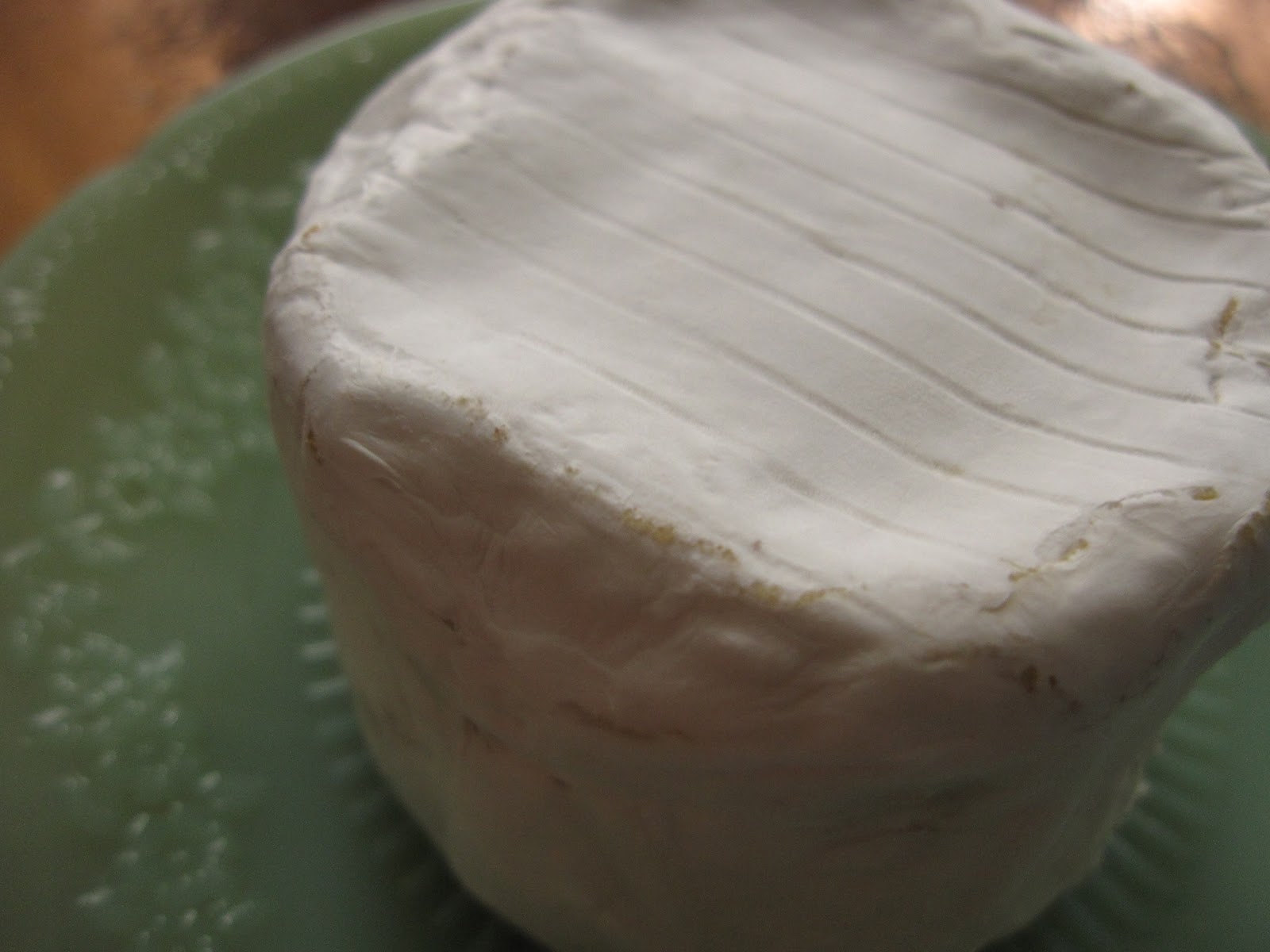
Out here in the East, the world is blizzard bright. Our street looks a little bit like Nuvola di Pecora, a bloomy sheep cheese with a mattress cover of snowy rind. It is pudding glorious and perfect for fattening up your snow-bound kin, which is exactly what I am doing.

My father is in town from the Great Plains, and we are enjoying moments of intrepidness, girding ourselves with fur. This afternoon we braved the wilds, hoping to make it down to the cheese counter, but we only made it as far as the liquor store before the wind blew us back home.
Padre Fromage

If only we had some Nuvola di Pecora in the fridge. If you like sheep’s milk cheese, this is a must-find delicacy. It tastes like sheep’s milk custard -- sweet and vegetal with a hint of steamed cauliflower and a clean, milky finish. It’s not muttony the way some sheep’s milk cheeses are, like the dense and delicious Shepherd’s Basket I tried several weeks ago.

Nuvola di Pecora means “sheep clouds.” Easy to remember. This is a cheese I will dream about – and visualize during sleepless nights, counting ONE Nuvola di Pecora, TWO…. If you can't find it at the cheese counter (it's a new release), beg your cheesemonger to seek this out.

Serve it with blackberry jam, preferably during a snow storm.

Nuvola di Pecora, Tait Farm Blackberry Jam

Friday, November 19, 2010

Shepherd's Basket: A Simple Supper

This is what my favorite meal looks like: a hunk of cheese, some good bread, roasted garlic, and some fresh herbs and vegetables. As winter comes on and holidays approach, I’m entering my lean cheese phase. All that means is that I forego meaty meals and heavy sauces for simple cheese boards at night.

Take yesterday, for example, I scrounged through the fridge and found this little wedge of Shepherd’s Basket, a cave-aged raw sheep’s milk cheese in the style of Romano. Cheesemonger Albert Yee, who sold me this hunk, told me he’d used it in a wonderful risotto for his wife. Risotto, I thought! Oh, risotto…

But then life got hectic-shmectic, and risotto became a pipe dream, so I set out to eat this cheese alone. I remembered that Shepherd’s Basket had a distinct smell of brown butter and lamb chops, so I poured some wine and went on impulse. What would I fix with lamb? Hummus. Garlic. Something green.

Out came the cast iron skillet, and soon I was roasting brussel sprouts in a little olive oil (350 for 30 minutes) with a few scraps of bacon. Then, I dug out my last radishes and sliced them up to garnish some hummus.


Lit the candles. Put on some jazz. And oh, what a feast. Of course, I had to ruin it by turning on all the lights and snapping a bunch of photographs, but then we sat down, and we ate, and the day darkened, and it felt like something essential had descended: warm food, rustic cheese, the smell of bacon.

Tell me, what is better?

Shepherd’s Basket comes from Valley Shepherd Creamery in Long Valley, New Jersey. It is a beautiful cheese, robust and sheepy with a walnuty hook. It paired so well with roasted garlic and olive bread that I don’t think I will ever eat it any other way again, unless it’s with chestnuts and honey.

Something for another supper perhaps.

Shepherd's Basket is available at the Fair Food Farmstand in Reading Terminal Market and at farmers' markets around Pennsylvania and New Jersey. For a full list, visit Valley Shepherd's website, or stop by the farm for a tour.

Wednesday, September 8, 2010

Martinis and Pecorino


I started back to work this week after summer vacation, and believe me when I say: Grrrl needed a martini. That put me in the market for an after-work cheese, something strong enough to stand up to gin. Enter Pecorino di Pienza, a Tuscan sheep’s milk cheese that loves olives, cured meats, and, oh yes, martinis.

Pecorino tends to get lumped among the grating cheeses – a shame. While it’s great on pasta and sautéed mushrooms, it’s an uncomplicated loner – salty, nutty, robust…worthy of cocktails and a stand-alone role. To read on, click here.

Full disclosure: This post is part of a series I'm writing for Di Bruno Bros., one of my fave cheese haunts in Philly. The deal is, I get paid to guest-blog for the store's site (dibruno.blogspot.com) on Wednesdays. I choose each topic myself.

Thursday, September 2, 2010

Otterbein Acres Camem-baaa

This little cupcake may just be one of the most exciting cheeses to come out of eastern PA. It’s Otterbein Acres' raw sheep’s milk Camembert, made by an Amish family in Cumberland County (namely, young Katie Fisher and her mother, Lena). I visited their stand at a farmers’ market in Carlisle, PA a few weeks ago, and I nearly wept when I tasted a sample. It’s mushroomy and aromatic with a gorgeously creamy texture.

You know I have a soft spot for sheep’s milk cheeses, and lately that emotional attachment has been nursed along by a new book, Liz Thorpe’s The Cheese Chronicles. Thorpe is the queen bee of the cheese case at Murray’s Cheese Shop in New York, and her new book has a fascinating section on sheep’s milk cheeses that explains why they are so rare. Ewes produce the richest milk, but they also have the shortest lactation period.
Interestingly, Thorpe spent some time in the Cumberland Valley visiting several Amish cheesemakers, which she describes in her book. She doesn’t mention Otterbein Acres, makers of Camem-baaa, but she clearly knows that those hills harbor glorious cheese. She talks at length about Goot Essa cheddar (which I saw in the fridge at Greensgrow last week, for all ye Philly locals). I’m sure that, by now, Liz has sniffed also out Camem-baaa.

If you like Hudson Valley Camembert, you’re in for another domestic sheepy treat. First of all, Camem-Baaa smells like snap peas. It has a vegetal smell that is just pure front porch. The texture is creamy but also springy, owing to the plush rind. I don’t want to put anyone off, but imagine a Camembert circus peanut. Now forget I said that.
The flavor notes of Camem-baaa: mushroomy, complex and earthy, with a hint of wool – “lanoliny” is how Liz Thorpe describes the sheepy quality in these cheeses. Still, there’s remarkable balance and complexity. Camem-baaa didn’t have any of the watercress-pepperiness that I remember from my mad nibbles of Hudson Valley Camembert. I could have let this downy snowball ripen longer, but I was too eager to cut into it.

Camem-baaa is not easy to find, but I happen to know that Paul Lawler is harboring some at the Fair Food Farmstand. And I’d wager that Murray’s has a stash. The Carlisle Farmers’ Market is adorable and worth a day trip if you live in the area – it’s the only market I’ve ever seen that sells whole-roasted Amish chickens. Plus, there’s a great little restaurant in Carlisle that serves local, seasonal food – more inventive than most in Philadelphia (I had in-house kombucha and sourdough chocolate cake.) Look for it: The Green Room.

Please, if you get a chance to try this exquisite little dome of cheese, let me know. I’d love to relive every sheepy note with you.

Sunday, August 15, 2010

Dante: Sharp & Sheepy

Lately, I’ve had a thing for aged sheep’s milk cheeses. Their nutty profiles pair well with stone fruits (cherries, apricots) and they’re perfect to serve on a muggy evening alongside a glass of white wine. Most sheep’s milk cheeses I see in stores are European imports – Manchego, Idiazabal, Abbaye de Belloc. Back in May, though, I tasted the best aged American sheep’s milk cheese I’ve ever eaten: Dante.

Dante comes from the Wisconsin Sheep Dairy Coop (WSDC), reputedly the largest sheep dairy in the U.S. The milk is gathered from just over a dozen small farms, and the cheese is made by hand. The same dairy also produces one other cheese, Mona, a mixed-milk wheel. Dante is 100 percent sheep’s milk, hormone-free.

Many sheep’s milk cheeses tend to have a mild flavor profile; their soft notes take time to develop on the tongue. To my mind, they’re like acoustic music – gentle and nuanced without the electric twang of, say, a farmhouse cheddar.

Dante, however, is a bit amped. There’s a pronounced sheepiness that I love, along with toasted nutty riffs that bring to mind marcona almonds. It’s got more chutzpah than your average Manchego but not as much sweetness as Idiazabal -- two Spanish beauties that would be fun to try alongside Dante, if you wanted to put on some Peter, Paul, and Mary and enjoy a sheep’s milk trio.

With its earthy, salty notes, Dante would be a great match for hard cider. A glass of Cava pairs well, too.

Thursday, July 22, 2010

Carr Valley's Marisa

Earlier this week, I nibbled my way around the Finger Lakes of New York state. One morning, a family friend invited Monsieur Fromage and me over to try her favorite cheese. We toured her garden, took a peak at her homemade pickles curing on the counter, and sat down to a mystery wedge that she served with Prosecco and a side of homemade chipotle-raspberry jam.
Jill Newton has been gardening and canning for 40 years. She makes a mean bread-and-butter pickle and was kind enough to share a few of her favorite recipes with us. But this cheese was what spoke to me, a sheep's milk cheese with a sweet, nutty taste that paired well with her piquant jam. Wouldn't you know it was from Wisconsin?!
"I got it at BJ's!" Jill was thrilled to tell me. It's interesting to see how much Wisconsin cheese makes its way out to New York and Pennsylvania. While I like to support my local cheese shops, I'm glad to see quality cheeses appearing in unlikely places. Even BJ's Wholesale Club.

Marisa is a cheese worth seeking out, especially for entertaining. It took 1st place in its class at the 2005 American Cheese Society Competition and 2nd place in its class at the World Cheese Competition. It's a cave-aged cheese, mild and sweet, without a pronounced sheepiness. At first, I mistook it for a cheddar. It has similar caramel notes and a flaky texture, although it's grainier.

Jill likes to serve Marisa with homemade pickles and jams. Perfect accompaniments. I look forward to doing the same. In fact, on August 28, I'll be teaming up with Marisa McClellan from the blog Food in Jars for a Cheese & Pickles tasting. More on that to come!

After our cheese visit, Jill Newton was inspired to start a blog about gardening and pickling. Check it out here.

Thursday, March 11, 2010

La Serena


Several months ago, while house sitting for our friends Noel and Carolyn in New York, I went through their cheese drawer – that’s right, some people go through bedroom drawers, I go through refrigerator drawers. One wedge intrigued me, a Spanish sheep’s milk cheese with a label that included “thistle rennet” among the list of ingredients. I filched a nibble and was transformed. This was an aromatic, vegetal cheese with a gooey center and a spiky aftertaste. Was I tasting thistles?
        
“La Serena” I typed into the notepad of my ipod.

For months now, I’ve been on the hunt to acquire my own wedge and to learn about cheese made with thistles. I’ve read up on rennet, which is an enzyme used in cheesemaking; often, it’s taken from the stomach lining of animals, but more and more cheeses include “vegetable rennet,” a coagulant that’s been introduced to appeal to vegetarians. Vegetable rennet is produced in labs, something purists pooh-pooh. Thistle rennet sounded sexy. It sounded natural.

In a curious twist of synchronicity, I found a wedge of La Serena at a local market the same week I received my latest issue of Culture Magazine, a new cheese rag with fabulous photo spreads. The cover story? Thistle Cheese.

So here’s the dealio: thistle rennet has been used in cheesemaking since ancient Roman times. Now, it’s used primarily in Spain, where it has evolved from cheeses that were made high in the Iberian mountains, thanks to some clever shepherds. The rennet actually comes from cardoons, those purple-tufted mega-thistles you’ve probably seen growing along roadsides. The stamens are steeped in warm water to make a “tea,” which is then added to the milk.

Amazingly, there isn’t a purple twinge to La Serena, but I thought I could detect the faint taste of artichokes, which are related to the cardoon. The cheese has a long-lasting sharp taste, like raclette, but its texture is much softer. If you let La Serena sit out for an hour or so, you can dip bread into it fondu-style. Beware the smell, howev, which calls to mind moldering grapes. It’s whiffy but wonderful.