Sunday, July 18, 2010

Cheese Cart Chronicles

This is a story about a fancy dining room overlooking a fountain. In the story, I play a cheese expert on a sniffing trip – a chance occasion to eat a complimentary dinner that includes a magnificent cheese course. It’s a true story, I should mention that. But it felt like a fairytale.

I went to the Four Seasons Hotel on Wednesday to dine at the Fountain Restaurant. Had I been there before? No. I am a diner lover and a taco joint regular. Most nights, I cook at home. That’s why this felt like a storybook. Whoever heard of being invited to the Four Seasons to “experience the cheese cart”? When I received the invitation back in May, I had to think for a minute -- I wasn’t sure I owned the right shoes.

Then I remembered I had some fancy red-leopard-print heels I’d never had an occasion for. Sure, I thought. Madame Fromage will dine at the Fountain in those leopard-print heels; they will be broken in by the cheese cart. And so away we went.

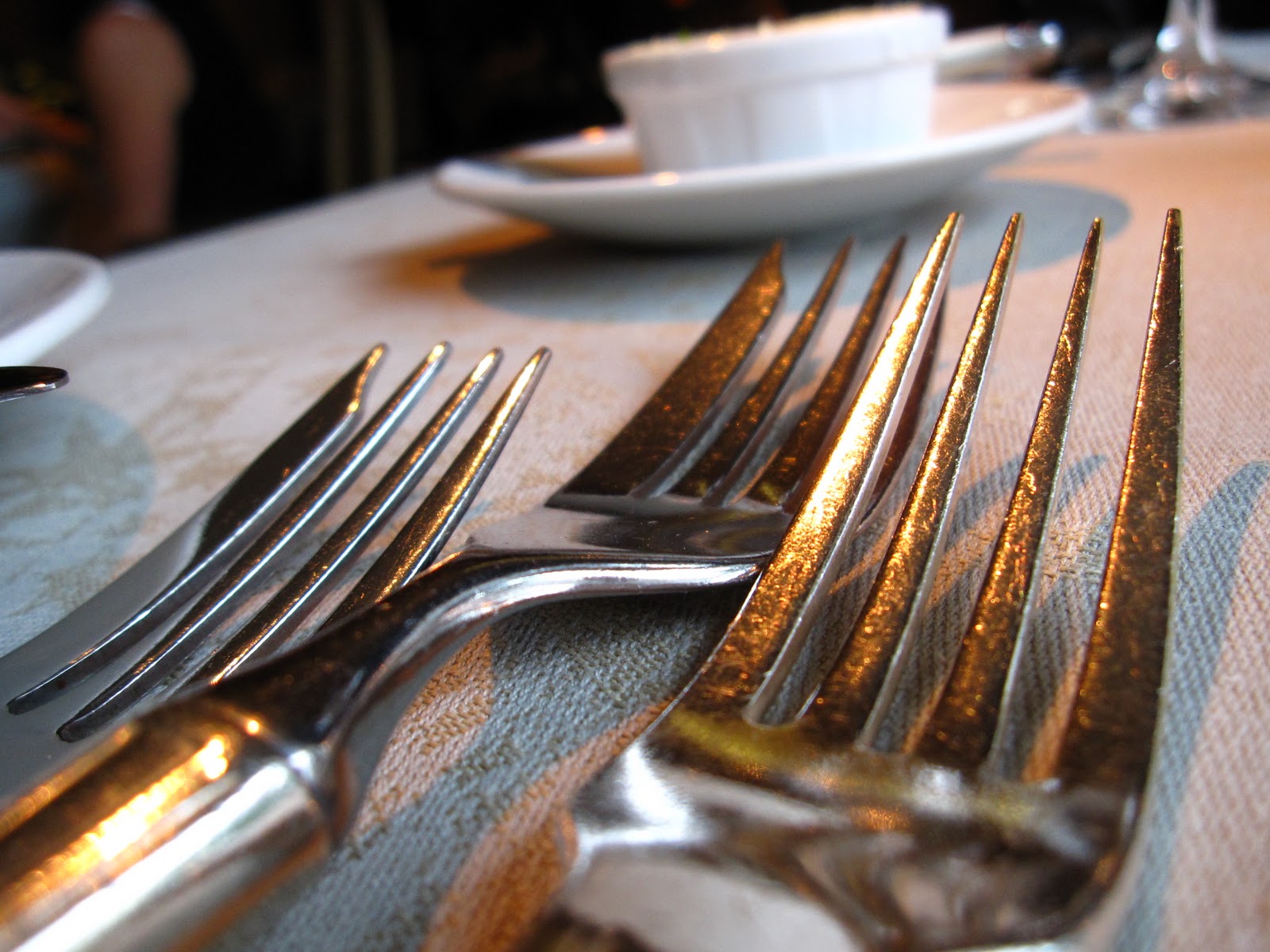
The Fountain Restaurant overlooks Philadelphia’s museum parkway. The dining room is grand, all chandeliers and plush carpet, and the table service is luxe – I went through at least eight forks. What I didn’t expect was that the chef would prepare his multi-course tasting menu for us. Monsieur Fromage and I ate five courses before we ever sampled from the much-lauded cheese cart. But, oh, those five courses were worth it.
I was especially struck by the emphasis on baby vegetables (tiny beets appeared as part of an appetizer, and the rabbit fricassee (below) was bejeweled with turnips the size of infant rattles.) Said rabbit was sourced from Branch Creek Farm in nearby Bucks County, an impressive farm-to-fork move for a restaurant that might be misconstrued as fusty. The shrimp, on the other hand, came from a sustainable source in Belize.

The service was impeccable, the wine pairings glorious. I am still thinking about the 2007 Bonterra Viognier, which tasted like a balsa wood crate of apricots. Gorgeous.

Chef William DiStefano, who prepared our meal, appeared just as we finished eating some perfectly prepared lamb with a lavender reduction, also exquisite. I had almost forgotten about the cheese cart. But then it appeared, a rolling trolley of wedges and wheels.

“Every week the selection changes,” DiStefano told us. “I talk to the people at Artisanal, and they help us put it together.”

I was curious to learn this, since I just finished reading Mastering Cheese, by Max MacCalman – the emporer of Artisinal, a fromagerie and bistro in New York with an impressive online cheese catalogue. Oh, I was not disappointed. The cheeses, they were exquisite. And so was the tray of accompaniments.

The cheese cart at the Fountain offers four categories of cheese – hard, soft-ripened, goat, and blue – which makes for interesting options. You can try all of a kind or mix and match. There were four top-of-the-line blues: Carles Roquefort, a true Cabrales, Blu del Moncenisio from Northern Italy, and Crater Lake Blue from Rogue Creamery in Oregon. What a nice sampling – I was pleased to see a state-side blue included in the selection.
For the cheese afficianado, there were some real jewels. Quickes Cheddar, made by Mary Quicke in Devon, England was an unexpected surprise. Mary makes traditional farmhouse-style cheddar from her own dairy cows, which graze on land that has been in her family for 450 years. It’s bound in cloth, larded, and aged for at least 18 months. I thought it was marvelous alongside honeycomb.

Hoja Santa, a goat cheese from Texas, was another suprise. This just might be one of my favorite new goat cheeses – I know, I know, I keep saying that. Paula Lambert of the Mozzarella Company makes this leaf-wrapped bundle that tastes of anise, mint, and sasparilla. No joke. The flavors come from the Hoja Santa leaf that Paula uses to wrap her cheese. If you try this, when you try this, ask for a snifter of Pernod.

There was also some superb Comte, a hard cheese that tastes like a Gruyere caramel. Imagine brown sugar, nuts, and leather. Mmmm, it was sharp and vixeny. Not your grandmother’s Gruyere. Alongside a pickled black walnut, this was extraordinary -- the stand-out pairing for me.

And so the story ends. But the memory lives on. The cheese cart at the Fountain Restaurant is a dream hive of dairy glory.

Wednesday, July 14, 2010

Muenster and Me

I've never been a big Muenster lover. This week, however, I had a brick of it to contend with from my local CSA farm share, and so Muenster and I had to reconcile. I had to pretend it wasn't the blandest of American-made cheeses and that I didn't feel disenchanted by its paprika coat -- enticing and yet flavorless. And so I decided I would dress Muenster up with some sexy bacon and the first heirloom tomato of summer.

If Muenster wasn't going to be my BFF, it was going to be my BLT.

Muenster has a reputable bloodline. French Muenster, the original, is beefy and nutty with "huge" flavor, according to cheese guru Steven Jenkins. Even the Germans and the Dutch make versions with some oomph. Americans, however, have taken the stink out of Muenster, and reduced it to a supermarket stepchild, a cheese that is rindless, odorless, and not the least bit beefy. It's the chicken McNugget of cheese.

But it does melt! Oh, yes. Drape a slice over toast and it goes limp, like a Victorian on a fainting couch. Hidden under lettuce and tomato, it finds quiet dignity, adding just the right note of milky ooze to a simple BLT. Just when I thought my favorite sandwich could not be improved, well, Muenster proved me wrong.


The key to a good BLT, of course, is the bacon and the tomato. If you have a great homegrown tomato, you can make a pretty sublime BLT. If you have stellar bacon, you can make ecstasy. I recommend Benton's, which is dry-cured and hickory-smoked. It comes from Tennessee, and it tastes like the Smoky Mountains. Like campfire. The smell is intoxicating.

Boyfriend and I cooked it on the grill in a cast iron skillet so that we wouldn't heat up the kitchen, but honestly, I wouldn't mind if the smell saturated every piece of furniture in the house. To me, it's potpourri.

Now I'm on the hunt for just one thing: a beefy French Muenster to go with it.

Sunday, July 11, 2010

Big Ed

I first read about Big Ed in the Washington Post. Here was a raw cow's milk cheese (with a great name) from my home state, and I'd never heard of it. How was this possible? Needless to say, when I traveled back to Wisconsin in May, I went on a hunt for Big Ed. He was coming home with me.

In Fromagination, a cheese shop in downtown Madison, I found him. What love! He was a 15-lb wheel with leaves embossed around the edge, about as pretty a cheese as I'd ever seen. I was smitten.

My brother and I had plans to host a small grilled-pizza party that night, as it was his birthday, so we picked up a selection of our favorite Wisconsin cheeses and decided to make an all-state blow-out of WI pies. We grabbed some Bleu Mont Dairy Bandaged Cheddar, some BelGioiosi Parm, some local mozzarella, a wedge of Dante (a stunning sheep's milk cheese), and a great slab of Big Ed.

Big Ed is a gouda-style cheese that comes from Saxon Homestead Creamery in Cleveland, WI on the shores of Lake Michigan. It's named after a guy named Ed Klessig, who supported his three sons in a cheese-making endeavor that began back in 2005. Now, the real Big Ed is no more, but his belief in being a steward of the land lives on, in part through this cheese. Saxon Homestead Creamery practices rotational grazing to produce about five high-quality artisanal cheeses. Saxony, their latest release, was just written up in Culture Magazine.

This might be a gouda-style cheese, but it's more flavorful than any gouda I've eaten. It's got a buttery texture, but the flavor profile is nutty, salty, and gently beefy -- we decided to test it against some sharp pizza ingredients, namely onions, mushrooms, black olives, and a whole load of chives.
Delicious. Big Ed melted beautifully and paired so well with the onions and olives. Our pizza party got a little rained out, but that didn't matter. We ate in my brother's garage, and even the chefs (my brother Andre, and his girlfriend Jen) managed to stay dry. And happy.

Wednesday, July 7, 2010

Sally Jackson Goat Cheese


Splendor has a new name: Sally Jackson. This small-batch producer from Oroville, WA makes one of the most glorious goat cheeses I’ve tasted to date. Talk about nuance, talk about flavor notes, talk about a cheese that pairs so beautifully with ripe apricots I nearly crumpled to the kitchen floor, weeping. Oh heaven, it comes in grape leaves. If you are reading this, log off. Get into your car. Drive to Oroville now.

Like her cheese, Sally Jackson’s web site is rustic. You won’t find a lot of detail, but you will see her rather small herd of animals, all lovingly pictured – in fact, there are many more photos of goats than cheese. Don’t let the low-fi design fool you though. Sally and her partner Roger are credited with being among the first artisans to bring back craft cheesemaking in America. Twenty years ago, Sally sold cheeses out of the back of her car to chefs in Seattle. Now, chefs stalk her.

I picked up my wedge at Di Bruno Bros. (Italian Market location) here in Philadelphia, where cheesemonger Zeke Ferguson told me the story of how he approached Sally Jackson five years ago about carrying her cheese. She just now got back to him. Needless to say, it’s not inexpensive, but at $39.99 a pound, it’s still cheaper than blue jeans, so, come on.

Here’s why Sally's cheese is worth tracking down: You know how ripe tomatoes smell on the vine -- pungent, like heat itself? Well, this goat cheese has a similarly captivating smell, like warm earth. Then you put it on your tongue, and it tastes completely different – not musty or goaty, but sweet, floral, almost grapey with a lovely citrus hook that just goes on and on until you’re starry-eyed.

Alongside apricots, it’s sublime. I think some of those little champagne grapes that burst in your mouth would be awesome, too. And I’d serve it with rustic bread – although it doesn’t need any – and a glass of Riesling. Honestly, I stood in the kitchen last night and ate half this wedge without meaning to, and now I think I am going to go eat some more.

If you’ve wondered why people freak for raw-milk cheese, this is why.

Tuesday, July 6, 2010

Curds 101: The DL from Limburger HQ


In Wisconsin, everyone loves a squeaky curd. In Philadelphia, most people have no idea what a curd is, let alone a squeaky one. I was at a party back in May when a New Yorker asked me, "So, what is a curd?" followed by, "So, how is cheese made?" Oh honey, he got an earful.

"A curd is like a unit of unripened cheese," I told him. "And a squeaky curd is super fresh. It actually goes wah-uh wah-uh against your teeth." He looked at me in disbelief.

Recently, I traveled back to 'Sconny to visit the fam, and I got to embark on tours of two cheese plants. The Wisconsin Milk Marketing Board set it all up for me and even gave me a shmancy tote bag. Such largesse! I felt pretty special and also kinda weird -- I don't know too many people who would wake up at 7 a.m. on their vacation to check out curd vats. But there I was, meeting Master Cheesemaker Myron Olson at the Chalet Cheese Co-op in Monroe, Wis. for a tour of his farmer-owned plant, the only producer of Limburger.
Olson has been a cheesemaker for 40 years, and he has the stride of a farmer. Big shoulders, slow walk. He smiles a lot, even when he's chewing, and he uses the word "shtink" with pride. I didn't mind putting on booties and a hair net for him.

First stop: the open vats where local milk is heated in tubs the size of Winnebagos. After rennet (a coagulant) is added, the milk solids settle to the bottom and the whey rises. I watched as two guys with cheese "harps" -- literally, metal frames strung with fine wire -- slowly raked the vats, a process called "cutting the curd."

When Olson reached in after the curds were cut, this vat of Limburger-to-be revealed handfuls of pebble-sized curds. Once these get pressed into forms, salted, and doused with special cultures, Limburger as we know it is born.
The Chalet Cheese-Coop is the only plant left in the country where traditional Limburger (and Liederkranz) is made. It's a real stinky hub.

I pecked at a few Limburger curds -- they were flavorless, like cottage cheese. After they are pressed and aged on pine boards, however, they turn into salty, oniony blocks of spreadable goodness. Olson let me sample Limburger at three different stages: an unripe Limburger tastes bland and chalky, at two months Limburger is creamy and pungent, and at three months Limburger is gooey and noxious, in the best possible way.

"Limburger is actually a probiotic cheese," Olson told me. "It's got a lot of good enzymes, so it's easy to digest. That might be why older folks like it." He chuckled. "Everyday I eat a piece of Limburger and I do stay healthy!"

Chalet Cheese Co-op does not appear to have a web site, although the company has fairly good distribution around the country at specialty cheese stores and many Whole Foods. New York, Florida, and Pennyslvania consume the most Limburger, believe it or not, which leads me to believe that some of my neighbors are holding out on me. I guess I'm not the only one who eats Limburger and strawberry-jam sandwiches around here.

Donna, pictured up top, is one of about 22 people on staff at Chalet Cheese Co-op. The company also produces German-style Brick cheese and award-winning Baby Swiss.

Note: for a list of factory tours around the state of Wisconsin, click here.

Sunday, July 4, 2010

Chocolate Chevre

In winter, I like to eat blue cheese for dessert. But in summer, well, that can be dicey. Take today, when it's supposed to be 97 in Philadelphia -- you couldn't pay me to eat Stilton. Well, okay, with the right port.

Still, I prefer the lighter cheeses on a sizzler, which is why today, I woke up thinking about this original chocolate chevre from Amazing Acres.

Several weeks ago, Debbie Mikulak dropped off a puck of this curious cheese she'd made, and -- I must admit -- I did a doubletake when I pulled it out of the paper bag. Typically, I don't go for flavored cheeses. Keep those hunks of mango out of my Stilton, please! A few days later, I got curious to try Debbie's chocolate chevre. She recommended serving it with berries and pound cake, which seems just about perfect for a 4th of July dessert.

I wish I still had some around.

Here's what I liked about this chevre: it's not too sweet. It looks like a mini chocolate cheesecake, but it doesn't taste like one -- no gooey consistency or cloying aftertaste. The dark chocolate flavor stands out, but it doesn't overpower the goat cheese. You can still taste a little tang.

With some cherry preserves and thin almond biscotti, you'd have bliss. I also have fantasies of sandwiching it between two amaretti cookies from Termini Bros. I'd serve it with a glass of Lindemans Framboise -- which tastes like liquid raspberries -- or some spiked coffee.

One other cheesemaker I know of sells chocolate chevre, Capri, out of Indiana. I would imagine you could also whip up some chocolate chevre yourself, using some good fresh goat cheese and some fiendishly dark cocoa. I'd use Green & Black's, which is Fair Trade and tastes divine in baked goods.

When the heat breaks around here, I'm going to try this recipe for Black Bottom Cupcakes with Goat Cheese -- I mean, as long as we're talking about dessert.

Friday, July 2, 2010

Madame Fromage Returns


June was a funny month. I didn’t blog. I didn’t tweet. Instead, I stole off to meet my muse along the Mississippi in order to finish a novel. The quiet setting was great -- plenty of turtles and river trails -- but I have to admit, I got lonely. I spent all day writing in a blue room and hardly ate any dairy, and that’s when I realized something: cheese is my muse, too.

When I meet a wonderful cheesemaker or peruse a beautiful dairy case, it makes me want to write. And that’s a brilliant discovery! I don’t know why I had to leave Philadelphia to figure that out, but I’m glad I did. When I stopped blogging in June, it was all I thought about. When I ate less cheese, wheels of Gruyere began floating through my dreams.

All this goes to say, I’m happy to be back. Back to the sunlit walls of my old kitchen. Back to my cupboards full of crackers. Back to my crisper crammed with cheese. Back to you. I have lots of stories to share in the coming weeks – from my visit to the Limburger cheese plant in Monroe, Wisconsin to my picnic at the underground “Pizza Farm.”

I also have some news.

Starting in August, I’ll be guest-blogging for Di Bruno Bros., one of my fave cheese shops here in Philly. I couldn’t be more excited. The Di Bruno folks have schooled me on everything from cheese mites to the beauty that is Montenebro, and they’ve been incredibly supportive of this blog. When they reached out to me in April, I was stunned. We ate some really ripe cheese together, and now it’s all love songs in the dark.

So here’s the deal: once a week, I’ll be posting on their store blog, Queso Files, and offering a link here. The appeal for me is that I’ll be able to give you, my dear readers, glimpses into the bat cave…insights into cheese-ripening, tales of artisan makers, and close-up shots of men with cheese tattoos.

As a former newspaper reporter, I love behind-the-scenes work, so I’m eager to get started. My first assignment? Interviews with Di Bruno’s top cheesemongers.